
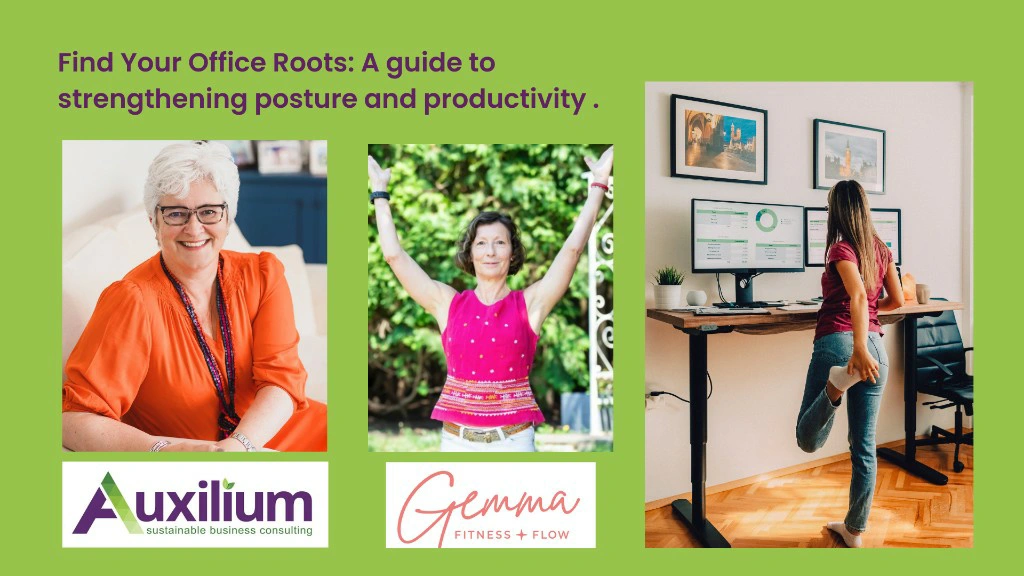
JOINT BLOG: Alex Hughes and Gemma Junyent-King
Many of us find ourselves glued to our desks for hours on end, so the importance of an effective desk setup and regular movement cannot be overstated.
Gemma Junyent-King and Alex Hughes have joined forces on this blog as they are both passionate about making sure you banish those daily posture niggles and make sure you are sitting comfortably and are taking regular breaks.
As we all navigate the challenges of remote work and traditional office settings, it becomes crucial to prioritise not just our productivity but also our physical and mental well-being.
Creating an Ergonomic Workspace
A well-designed workspace is foundational for promoting good posture and reducing the risk of musculoskeletal issues. An ergonomic desk setup featuring an appropriately positioned monitor, chair, and keyboard can significantly enhance comfort and efficiency. However, even the best ergonomic setup cannot compensate for the dangers of prolonged sitting. Research shows that sitting for extended periods can lead to a host of health problems, including obesity, cardiovascular disease, and chronic pain conditions
The Power of Movement Breaks
Incorporating regular movement into our workday is essential for counteracting the negative effects of sedentary behaviour. Short breaks for stretching or light exercise can rejuvenate both body and mind, enhancing mental clarity and productivity
Simple activities like desk stretches or walking meetings can help alleviate stress and combat fatigue, allowing us to return to our tasks with renewed focus
Integrating Exercise into Daily Routines
Finding ways to integrate physical activity into our daily routines whether through scheduled breaks or spontaneous movement can foster a healthier work culture. Engaging in exercise not only reduces stress levels but also boosts overall performance by improving blood flow and oxygen delivery to the brain. Making time for physical activity during work hours can help employees feel more energized and motivated throughout the day.
As we explore the intersection of desk setups and exercise breaks in this blog, we aim to provide practical tips and insights that empower you to create a healthier work environment. By prioritising movement alongside a well-structured workspace, we can all enhance our well-being and productivity in today’s demanding work landscape.
Making sure you have the right desk set up is critical for lots of reasons – but what type are you?
- Everything Out = someone who needs visual clues and reminders.
- Nothing Out = Someone who dislikes clutter and mess and wants things hidden from view.
- Saver = Someone who feels that everything might be handy at some point.
- Minimalist = Someone who regularly reviews their desk and frees up items.
- Straightener = Someone who likes to lines things up but sometimes this doesn’t make sense.
- No Rules = disorganised and lacking systems and routines.
N.B. You do not have to fit into one category but are likely to be a combination of the above and especially at different times of the day.
Alex says ” When I am busy I might be an everything out, then a straightener and then a nothing out at the end of the day.”
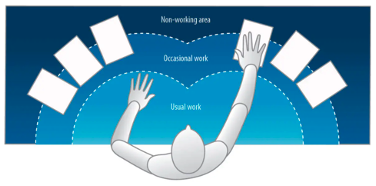
- Desk Zones.
Usual or Primary Zone – for regularly used items such as your keyboard, mouse and writing materials
Occasional or Secondary zone – for items that you occasionally use such as mobile, iPad, or post its.
Non working area or Tertiary zone – for items that are rarely needed ( or perhaps should not be on your desk) such as reference materials, other stationary or personal belongings (keys & ornaments)
The desk must be clear and free of items and so it is important to consider whether any items that are stored on your desk and around you are always needed. Make room where you can by storing them away or moving them to an alternative place in reach or on a shelf or in a cupboard.
The closest items that you need regularly should be in your ‘usual work area’ and if you have space, place/store others set back in the ‘occasional and preferably the non-working area’ or on shelves or in a drawer.
Gemma says “Posture is the foundation of body movement, the starting point for daily activities that include squatting, lunging, hinging, pushing, pulling and rotating.”
- Posture – Proper posture involves maintaining alignment through strength, flexibility and balance, which is crucial for executing these fundamental movements effectively improving our overall physical performance and safely -reducing the risk of injury.
Good posture is essential for both everyday activities and athletic pursuits.
- Taking Breaks – Aside from the mental benefits of taking regular breaks from the desk every 30 to 45 minutes, my suggestion is to stack Movement breaks before or after toilet and water breaks.
- Exercises – As bipeds, I recommend starting with our feet (even when sitting) and continuing with our ankles, knees, hips, shoulders, and neck – Heel Raises, Back Stretch, Squats, Body Rolls, Full Body Reset.
3 Top Tips from Alex
- Frequently change your posture and take opportunities to move away from your desk to help those niggles. https://www.posturite.co.uk/media/pdf-downloads/active-working-sit-stand-desks-advice-sheet.pdf
- Check your chair has lumbar support to help you maintain proper posture – https://www.posturite.co.uk/media/pdf-downloads/Art-of-Sitting.pdf
- Make sure that your monitors are all at eye level and about an arm’s length away to reduce neck and eye fatigue.https://www.posturite.co.uk/media/pdf-downloads/Monitor-Arms-and-Stands-A4_2019.pdf
Alex Quote
‘It is more important than ever now that your desk/office set ups are reviewed regularly, and any health niggles avoided by minor changes and purchases of suitable equipment and furniture. Creating the right desk configuration that is tailored to your needs is vital for your well-being and performance.’
3 Top Tips from Gemma
- Connect your mind to your body -aka Mind-Muscle Connection.
- FEEL and CHECK your main joints: ankles, knees, hips, shoulders, neck -several times a day, before getting up and before going to bed. Mobilise your main joints consciously. Be present in each move -as opposed to moving mechanically, with your attention elsewhere.
- Enjoy it. Love it.
Gemma Quote
“’Posture can be relearnt through short movement routines during desk breaks.
Try adding 3–5-minute movement routines several times a day (ideally while taking toilet & water breaks) and you can feel sound improvements within a few weeks.
Give your body some love and it will love you back’.
We do hope this blog has been useful and do get in touch with either of us if you need further information or you have any questions. Our details are below.
Auxilium Business Consulting Ltd
Alex Hughes is a small business consultant helping service-based business owners take a helicopter view of their business to make it efficient and effective with sustainable
Solutions.
She has 17 year’s experience as an operations manager and has completed 100s of annual Display Screen Risk Assessments for employees to create a safer, more comfortable, and more productive work environment while meeting their legal obligations and potentially reducing costs associated with work-related health issues.
What is a DSE Risk Assessment?
First of all, DSE stands for Display Screen Equipment, but don’t be fooled it’s not just the equipment set up and how you use it, it’s also about the environment you work in and your health and wellbeing.
A DSE risk assessment is undertaken by an Assessor who can identify areas that are not compliant with regulations, and or suggesting tweaks for the person to make improvements and providing a report with recommendations.
Incorrect use of DSE or poorly designed workstations or work environments can lead to pain in necks, shoulders, backs, arms, wrists and hands as well as fatigue and eye strain. The causes may not always be obvious.
For further information please take a look at Alex’s services
Alex Hughes – Auxilium Business Consulting Ltd
https://www.linkedin.com/in/alex-hughes-sustainable-business-solutions
Book a Free chat with Alex here
Gemma Fitness and Flow
Gemma Junyent-King is a Fitness Coach, Personal trainer, Yoga and Pilates teacher who specialises in Corporate Wellbeing helping Desk Workers keep Fit and Functional during Desk Breaks.
She has 15 years of experience in Health Clubs where she specialised in senior populations and children with special needs.
She takes Private Sessions and Group Sessions both Online and In Person.
For exercise instructions, please email her at Hello@GemmaFitnessAndFlow or connect with her via LinkedIn or FB.
https://www.linkedin.com/in/gemma-junyent-king