
Many businesses proudly describe themselves as green.
Being a responsible business is not proven by one or two environmental gestures. It is proven by how you operate every day with your people, your suppliers, your customers, your community, and your decisions. “Green” is often used as shorthand for “good”, but sustainability and CSR are much broader than the environment alone.
This article sets out a clearer, more credible way to talk about responsible business, especially for micro and small businesses that want to do the right thing without getting lost in jargon or perfectionism.
Why people assume they’re “green”
Most businesses aren’t trying to mislead. They’re trying to be better with the time, knowledge, and resources they have. The issue is that certain actions have become widely recognised as “green signals”, so people naturally stop there.
Common reasons businesses believe they are green include:
- They recycle
- They host their website on renewable energy
- They work remotely or avoid commuting
- They use paperless invoicing and digital contracts
- They avoid single-use plastics in the office
- They buy “eco” stationery and cleaning products
- They use sustainable packaging or offer a “green” upgrade
- They source locally where possible
- They donate to charity or sponsor community events
- They plant a tree for every order
- They purchase carbon offsets
These are not wrong; they are simply incomplete.
If a business is doing these things while underpaying staff, squeezing suppliers, ignoring customer data protection, or making unsubstantiated claims, and not telling the world the good things they are doing, then it isn’t operating responsibly, no matter how good the recycling is.
The shift: from “green actions” to “responsible operations
A useful way to reframe this is:
Recycling is a tactic. Sustainability is operational.
Responsible business is shaped by the decisions you make repeatedly and how you run the organisation, how you treat people, how you buy, how you sell, and how you show evidence.
The CSR Confidence Journey
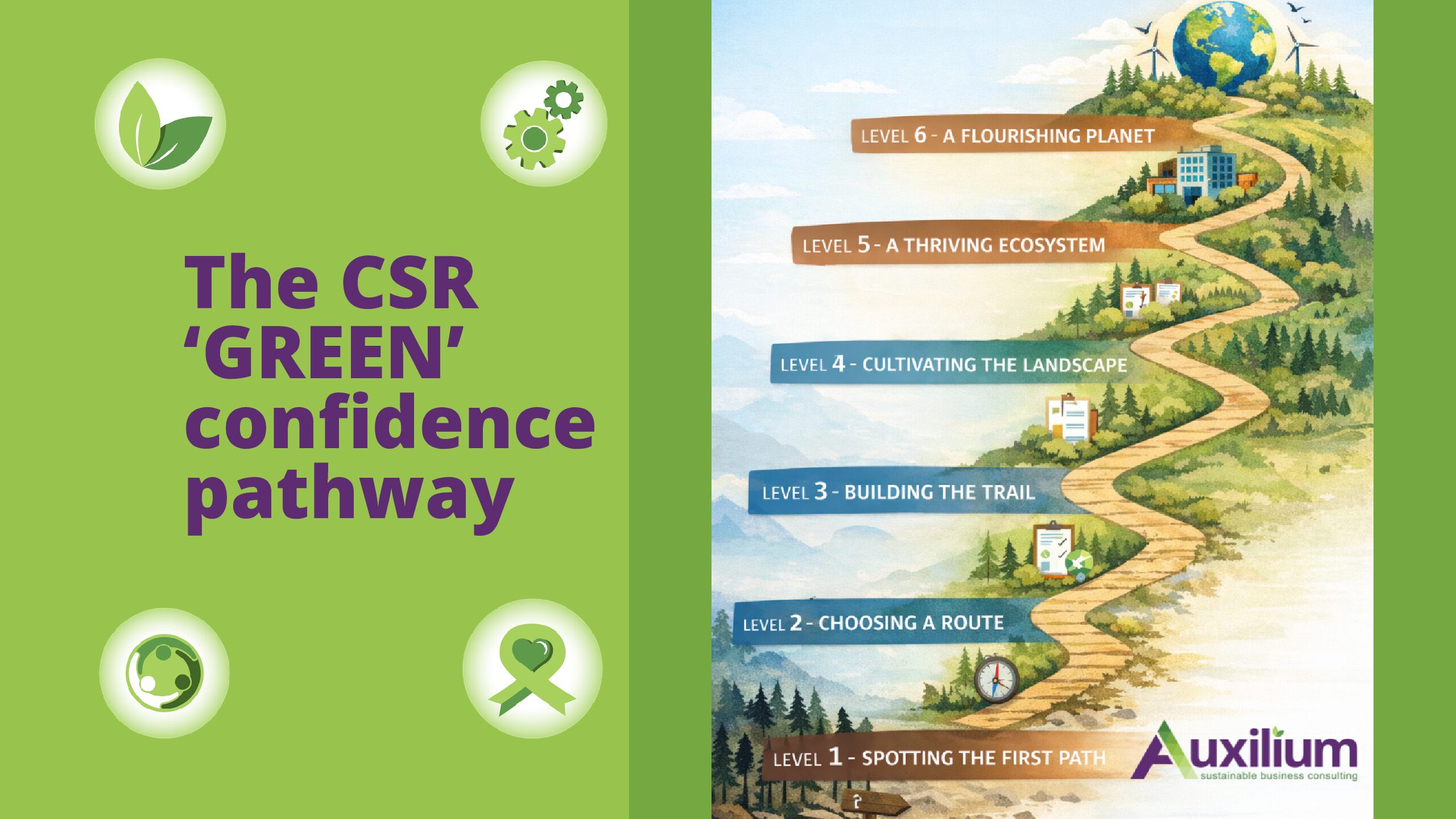
The six labels on the image of this blog describe how most micro and small businesses grow in CSR, moving from isolated “green” actions to responsible operations that can be evidenced and trusted.
- In the Wilderness — CSR feels unclear or irrelevant; day-to-day survival drives decisions.
- Spotting the First Path — early visible steps (often environmental) but still ad hoc.
- Choosing a Route — intention appears; priorities are selected, and responsibility becomes clearer.
- Building the Trail — consistent practices begin; basic policies and repeatable routines take shape.
- Cultivating the Landscape — impact is measured; decisions start to be guided by evidence and targets.
- A Thriving Ecosystem — CSR is embedded into daily operations; people, suppliers, and decisions align with your values.
- A Flourishing Planet — you lead with transparency and collaboration, influencing beyond your business through measurable impact.
If you want an external framework to underpin this journey, then the CSR-A (CSR Accreditation) is built around the four pillars of Environment, Workplace, Community, and Philanthropy, and collectively they provide a structured way to collate, measure, and report what you already do, then plan improvements with a clear roadmap and ultimately gain an accreditation.
This is the difference between looking green and being responsible.
If you want to be seen as a genuinely responsible business, don’t lead with a single “green” claim; lead with how you operate.
Yes, recycle, reduce waste, switch tariffs, and make smarter choices, but also look at the workplace you create, the suppliers you depend on, the community you touch, your philanthropic efforts and the principles and values that shape your decisions.
Because BEING GREEN isn’t a badge you earn from one action. It’s a way of running your business that stands up to scrutiny and builds trust.