
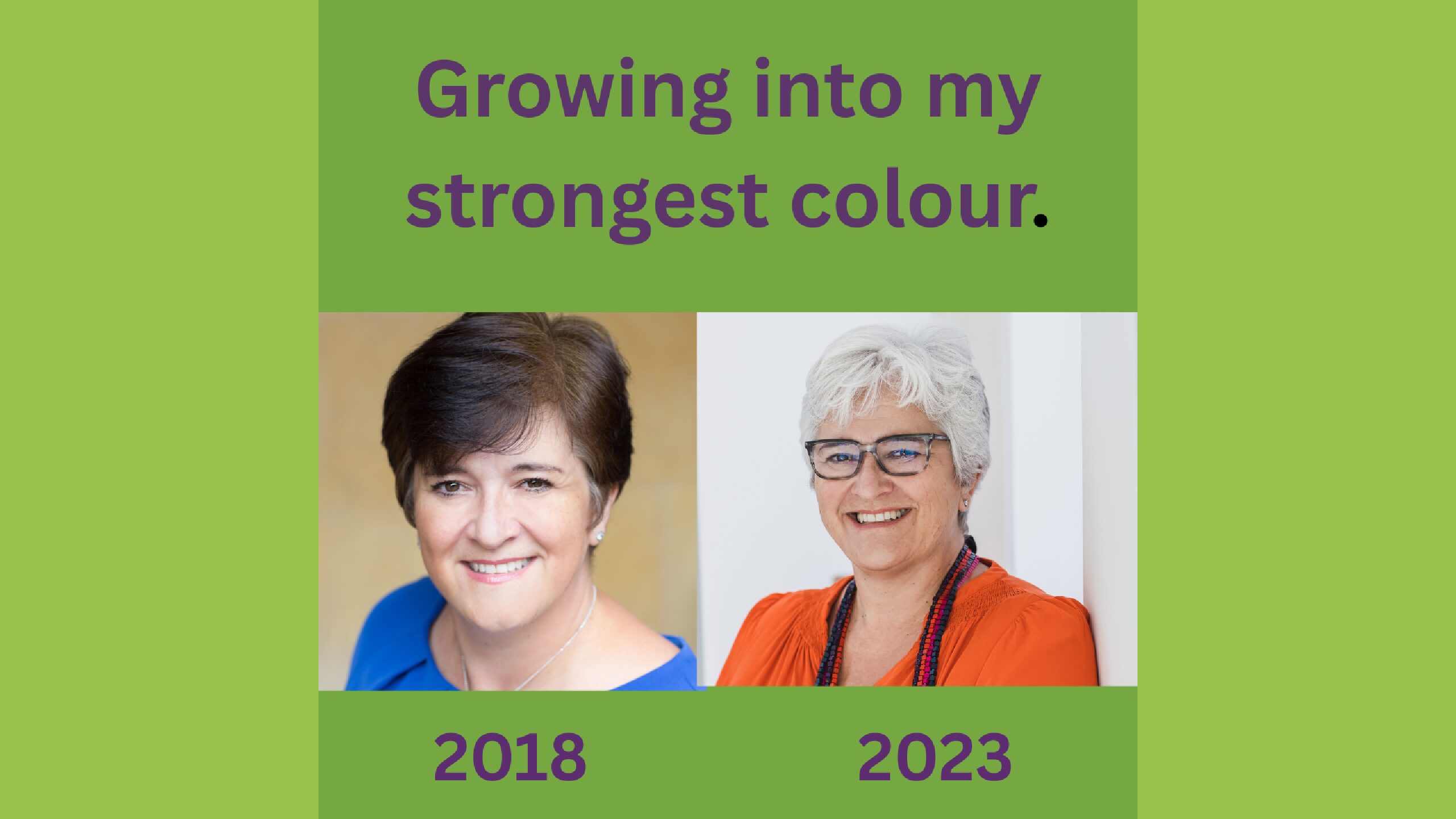
My Brown-to-Grey transition
For most of my life, my hair was one of those things I never had to think twice about. I always had a thick head of dark brown hair; it always went in the style I wanted it to, and when I was young, it was long and the sort of hair that becomes part of your identity without you even realising it.
I was born with a thick head of hair, and my brother teased me when I was young, saying it looked like a “loo brush”
My hair, back then
In my teens, swimming became a regular part of my life; long hair stopped being practical, and I decided to cut it short, and it has stayed that way ever since, with a few forays into shoulder-length hair that were swiftly cut back. So short hair became my normal: easy, familiar, and “me.” It suited my lifestyle, and for years, it felt effortless.
When the grey first appeared
Then, in my late 40s, I spotted my first stubborn grey hairs. At first, it was only a few and nothing dramatic. But once you notice them, you really notice them. And so I did what many of us do without even thinking: I tried to cover them.
When the dye didn’t do what it promised
The problem was that it was never covered properly. The sides were especially stubborn. I’d dye it and still see the grey peeking through, as if my hair was politely refusing to cooperate.
So I tried highlighting it a few times instead, thinking that blending might be the answer. It helped a little, but something still didn’t feel right. The results were inconsistent, and the process started to feel like more work than it was worth.
The turning point: discovering the allergy
Then the real issue became impossible to ignore: I realised I was allergic to hair dye, all except for one brand I could tolerate. That changed everything. Because once it becomes a health issue, you stop seeing it as a cosmetic choice and start seeing it for what it is: your body giving you clear feedback.
A practical plan
When I told my hairdresser, he didn’t make it dramatic; he made it doable.
Instead of fighting my way back to a solid brown, he suggested we go in the other direction. The plan was simple: use the one dye I could tolerate, then take my hair one shade lighter two or three times. The aim was to gradually move towards grey so the transition looked intentional rather than accidental.
A slow graduation. A considered shift. And it worked.
Not in a “perfect magazine before-and-after” way, but more in a real-life, in-the-mirror, “this finally feels like it’s making sense” way. The lighter shades softened the contrast. The grey stopped looking like something I was failing to hide and started looking like something I was choosing to reveal. The change wasn’t sudden. It was steady.
Why the in-between phase matters
That steadiness mattered because the in-between phases can be uncomfortable. You don’t feel like your old self, and you’re not quite the new version yet either. But the gradual approach gave me space to adjust and, unexpectedly, it gave other people space to adjust too.
What surprised me most: the comments
I expected opinions. Everyone has opinions about women and ageing, whether they admit it or not. But one comment in particular kept showing up, and it started to bug me more than I expected:
“You’re so brave!”
I know it’s meant as a compliment, but it lands oddly because what people often say next is:
“It looks really good on you… But I could never go grey.”
I was even once told by an actress friend that she couldn’t “go grey” as she would never get a job. Cue my mind thinking of all the actresses and actors, for that matter, who have amazing grey hair, and it hasn’t stopped their career!
These little add-on tells the real story. It isn’t just praise; it’s a confession of fear. To me, it suggests that grey is something to endure rather than embrace. It can look acceptable on someone else, but it would feel like “too much” on them. That looking older is the problem, and the “bravery” is in letting it happen.
But here’s the truth: my decision wasn’t bravery. It was practicality, and most importantly, it was my health. It was a decision to stop wrestling with something that wasn’t serving me, and to stop spending money, time, and energy chasing a result I couldn’t reliably get anyway.
And if I’m honest, the idea that I’m “brave” for wearing what naturally grows out of my head says more about the pressure women are under than it does about me.
What I wish people understood
If you want to compliment someone’s grey, you don’t need the disclaimer. You don’t need the “but I could never…”
Try this instead:
- “You look confident.”
- “That colour really suits you.”
- “You look like yourself.”
Because that’s the point. This isn’t about letting yourself go. It’s about letting yourself be.
What I gained by going grey
The biggest change wasn’t the colour. It was how I felt about myself.
I felt lighter, not just because I wasn’t fighting my hair anymore, but because I wasn’t performing quite as much. I wasn’t trying to maintain a version of myself that existed mainly to reassure other people.
And on a practical level, I got my time back. I got my headspace back. I stopped living by the “root clock” that low-level pressure that creeps in when you feel you have to keep up appearances. There is something quietly powerful about deciding you don’t have to.
If you’re considering the transition to going grey, whether because you’re curious, tired of the upkeep, or because your body is telling you “enough”, I’ll say this: Do it in a way that supports you.
There’s no one correct method. Some people go cold turkey. Some blend with highlights. Some transition gradually. Some cut it short and reset. What matters is that it feels like your decision and it is not a surrender, and not a statement you’re making for anyone else.
And if you’re in the awkward middle phase where it’s neither one thing nor the other, you’re not doing it wrong. That stage is normal. It asks for patience. It asks for kindness. It asks for a little trust.
A few other things to consider during and after are that the colours of clothes and makeup you wear will change, so I would advise taking some advice about this from professionals.
Other things to think about are perhaps using a purple shampoo to maintain the lustre of your hair and strip out any yellow ends, and having your hair cut regularly. Think about your healthy choices of food and moisturisers, and perhaps the colour and shape of your glasses and take more time to take care of your new self.
In conclusion, when growing into my strongest colour
I didn’t lose something when I stopped chasing brown.
I gained something.
I gained ease.
I gained honesty.
I gained a look that matches how I feel inside: experienced, capable, and still moving forward.
So no, I’m not brave. I’m simply growing into my strongest colour.