
In practice, “responsible & ethical” is often assumed until something goes wrong. Then it becomes decisive.
I recently ran a short poll asking:
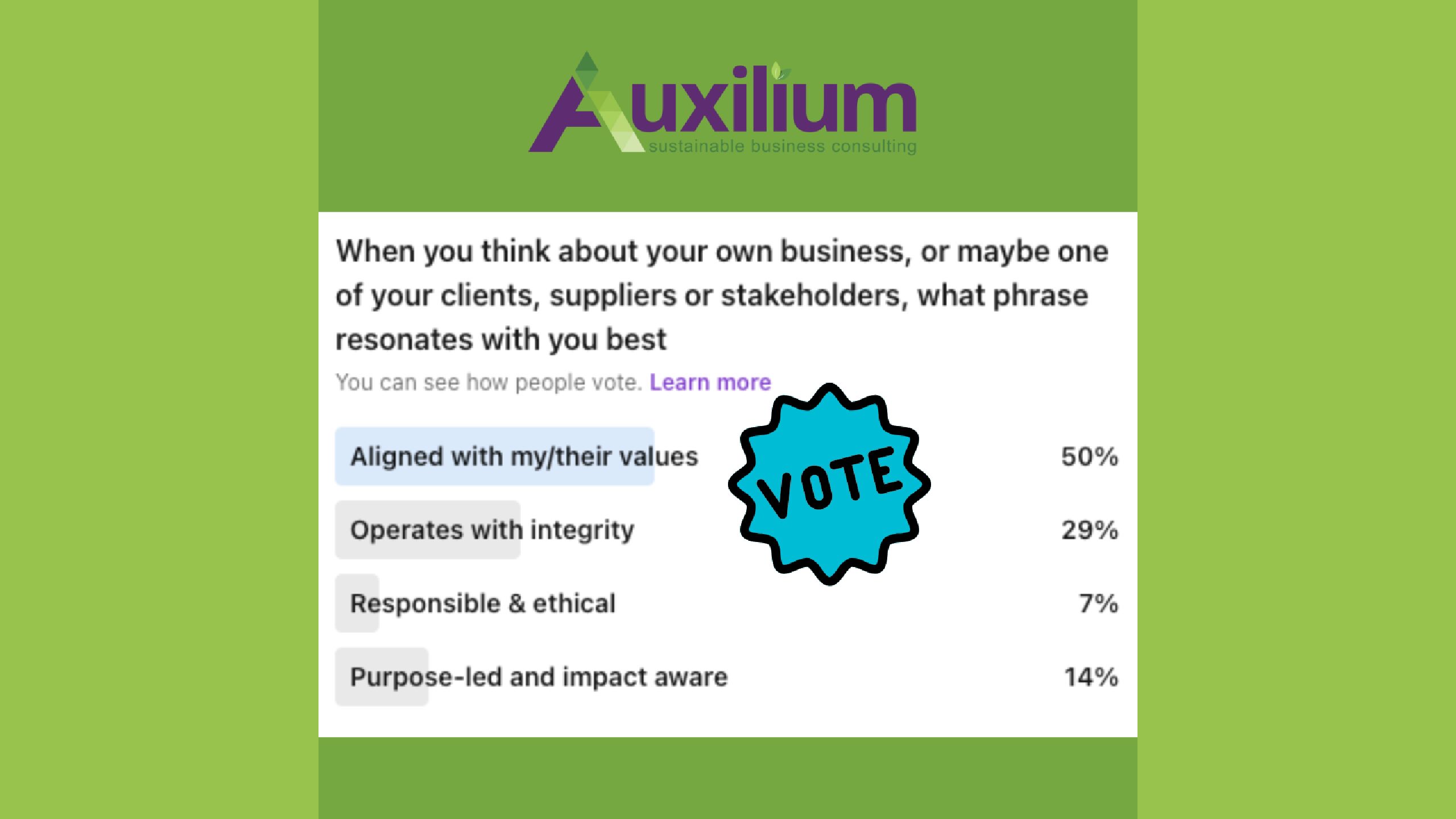
“When you think about your own business, or maybe one of your clients, suppliers or stakeholders, what phrase resonates with you best?”
The poll closed with 14 votes. It is a small sample, but the pattern is consistent and the written comments add real depth.
Poll results
- Aligned with my/their values — 50%
- Operates with integrity — 29%
- Purpose-led and impact aware — 14%
- Responsible & ethical — 7%
Who responded (and why it matters)
This was a mixed professional audience: coaches, consultants, strategists, animators, GDPR experts, operations consultants, nutritionists, VAs, accountants, ethical board members, a purpose-led speaker/coach and an OBM.
These are roles that typically see the difference between stated intentions and actual delivery. So the results lean toward what is observable and proven.
What each option is signalling (and how they connect)
1) Aligned with my/their values (50%): lived behaviour and consistency
The comments made this definition practical:
- D&I is real (including gender equality), not performative
- Brand is embodied, not “stickered on”
- Client outcomes matter; support does not disappear after payment
- Less talk, more action”
- Respect, honesty, and mature challenge
- True partnership and shared aims
This option is the broadest and arguably the most commercially relevant because it combines how people behave with how work gets delivered.
2) Operates with integrity (29%): the proof mechanism for trust
Integrity is often the test of values. It answers:
- Do they do what they say they will do?
- Are they transparent when something changes?
- Do they honour commitments, timelines, and boundaries?
- Will they tell the truth early rather than manage perceptions?
Integrity is also what makes “values aligned” believable. Without it, values remain a claim.
3) Purpose-led and impact aware (14%): direction plus evidence
Purpose appeals when it is:
- Clear about the “why”
- Backed by decisions that show trade-offs
- Translated into measurable outcomes
This sits below values and integrity, likely because many people have seen purpose used as marketing language. The respondents appear to want a purpose that is operationalised and built into priorities, service delivery, procurement, and leadership choices.
4) Responsible & ethical (7%): baseline expectation, unless proven in hard moments
A low score does not mean ethics is unimportant. It may indicate it is now considered a minimum requirement and the minimum expected of any credible organisation.
Ethics becomes a differentiator when it shows up in the difficult areas:
- How conflicts of interest are handled
- Whether people are treated fairly when it costs money
- Whether the organisation is willing to lose business rather than compromise standards
- Governance, data protection, and duty of care done properly
What the comments reinforce: values are experienced, not stated
Across the written feedback, people are asking for the same thing in different words:
consistent leadership behaviour
inclusive practice (not performance)
honest, respectful communication
partnership and follow-through
client outcomes over quick wins
One respondent shared that they left paid employment when values no longer aligned. Another said they have deliberately aligned their business with their values, and it now attracts the right clients. That is a strong signal that values are not “soft”; they shape real decisions and commercial outcomes.
Practical next steps for leaders and business owners
Turn each poll option into an observable standard
- Values aligned: defined behaviours; meeting culture; inclusion in decisions; how disagreements are handled
- Integrity: promises kept; transparency; early communication; accountability
- Purpose-led: priorities linked to impact; measurement; proof points; trade-offs made visible
- Responsible & ethical: governance; fair practice; boundaries; data protection; doing the right thing when it costs
A simple test
Would a new client, supplier, or team member feel these standards in the first two weeks?
If not, your values are probably still living in words rather than work.
Closing reflection
This poll reinforces a forward-looking truth: people are moving past slogans and toward evidence. They are looking for organisations whose values are visible in daily behaviour, whose integrity is proven through follow-through, whose purpose is translated into measurable impact, and whose ethics show up in the decisions that cost time, money, or convenience.
In other words, these four qualities are not what you claim; they are what others consistently experience, especially when priorities collide, and the pressure is on.